



Date: 20 May 2025
Author: Charlotte Hume
The story you remember about Blockbuster is wrong. And history is repeating itself.
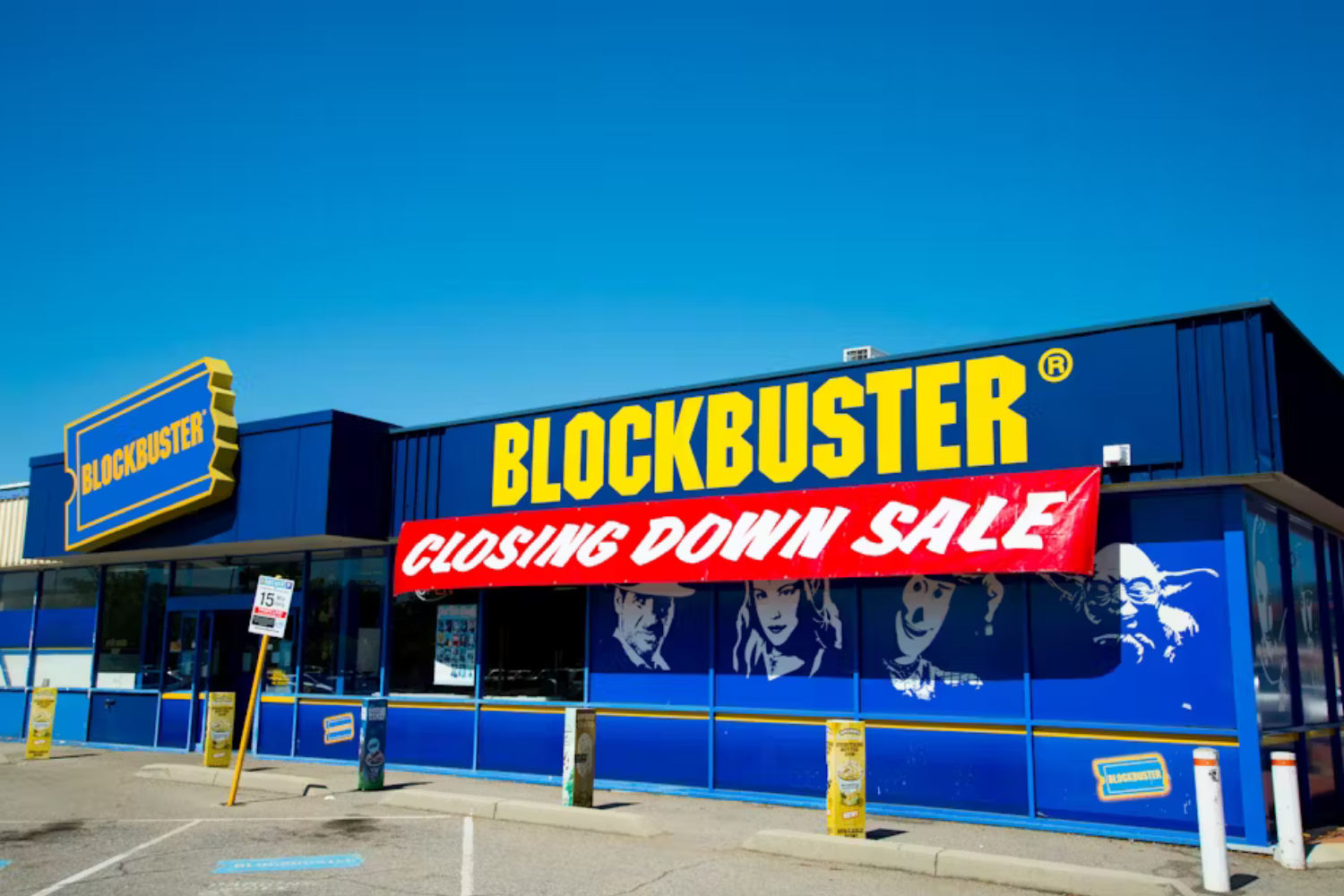
Most people believe that Blockbuster failed because it didn’t embrace new technology. But that’s not what happened.
Blockbuster did adopt new tech. It launched a website. It built an online rental platform. You could browse from home and reserve a DVD to pick up in store. It even introduced a DVD-by-post service to compete with Netflix. At its peak, Blockbuster had over 9,000 stores around the world. But all of this was designed to drive more people into those stores. The internet was used to increase footfall, not to question whether physical shops were still necessary.
And to be fair, you can understand why. Around 25% of Blockbuster’s revenue came from non-rental income like late fees, snacks, and DVDs for sale. The store wasn’t just part of the business. It was the business model. In that context, protecting it made sense.
That was the real mistake.
While Blockbuster used new tools to make its existing model more efficient, Netflix used the same tools to build something completely different.
Netflix was founded in 1997 by Reed Hastings and Marc Randolph. In 1998, they launched a website offering around 900 DVDs for rent. The idea was simple: browse online, get the DVD delivered to your door, and post it back when you were done. No queues. No due dates. No late fees. You may remember some of the first titles: Twister, The Fugitive, Batman Forever. The insight was not just logistical. It was structural. Netflix did not just cut out the shop. It reimagined the rental model altogether. And when broadband internet became widespread, Netflix made its next move. In 2007, it introduced streaming. No discs. No postage. Just click and watch. The store was gone.
Blockbuster followed, but always with the same goal — to protect what it already had. Online bookings. Postal returns. Loyalty schemes. But it never asked the deeper question. Now that this technology exists, do we still need the store at all? By 2010, Blockbuster filed for bankruptcy. This is not just a story about video rentals. Every industry faces the same choice. Use new tools to make existing processes more efficient, or step back and ask what those tools now make possible.
I work in process safety. It is a field built on structure, documentation, and long-established systems. AI is already showing it can summarise technical reports, analyse large volumes of data, and even generate content for a safety case. But if AI can write the safety case, do we still need to produce it in the same format? If it can accelerate a HAZOP, is the real value in speed, or in changing how we identify and manage risk altogether?
When someone says AI can help us do something faster, it is worth asking a different question. Should we still be doing it at all?
What would it look like to reimagine process safety entirely?
Imagine a system where risk assessments are no longer one-off workshops but continuous, data-driven processes that evolve as operations change. A system where frontline teams interact with a live digital model of their operation that flags emerging risks in real time. Where the safety case is not a document, but a shared, transparent environment that everyone can query and contribute to. A living system of assurance — not a static PDF buried in a folder no one opens. That world is closer than we think. The tools are already arriving. The challenge is whether we use them to improve what we already do, or to design something new. These are the conversations I am not hearing enough of.
The future will not be built by those improving the store. It will be built by those who realise we do not need one.
David Jamieson | Salus Founder
Subscribe and receive our updates via email.
"*" indicates required fields